
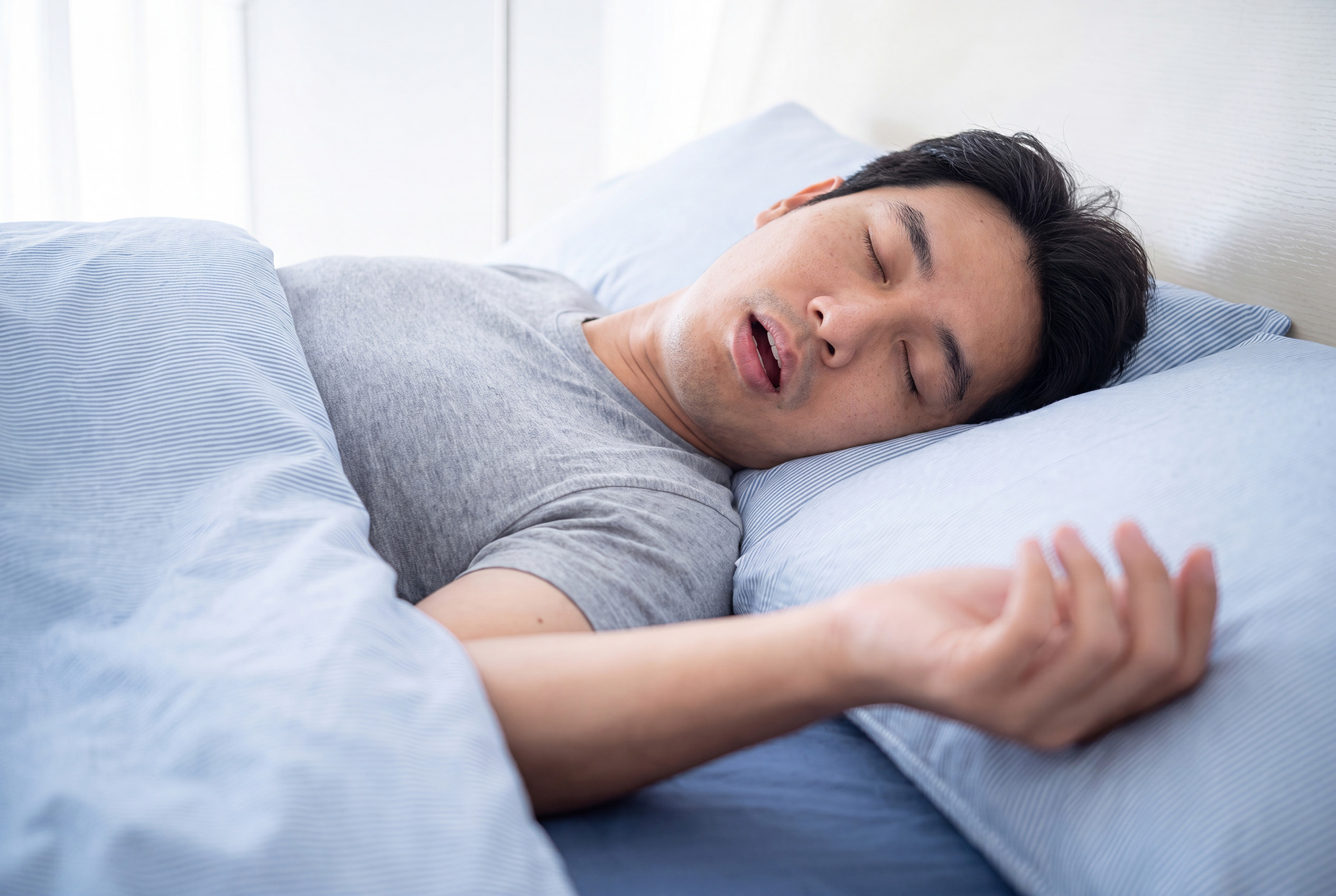
Snoring is common, but it is not always just a night-time disturbance. In some people, loud or persistent snoring may be associated with obstructive sleep apnea, also known as OSA.
Obstructive sleep apnea occurs when breathing repeatedly reduces or stops during sleep because the upper airway becomes partly or fully blocked. HealthHub Singapore lists symptoms such as daytime sleepiness, dry mouth or sore throat upon waking, morning headaches, trouble concentrating, snoring, and sudden awakening with gasping or choking.
Not everyone who snores has OSA. Symptoms alone also do not confirm the condition. A proper sleep assessment is usually needed to understand whether OSA is present, how severe it may be, and what treatment options may be appropriate.
For some patients, the jaw, bite, oral structures, facial anatomy, or suitability for an oral appliance may form part of the assessment. This is where an oral and maxillofacial perspective may be relevant.
Snoring and sleep apnea are not the same
Snoring happens when tissues in the upper airway vibrate during sleep. Obstructive sleep apnea is different because breathing repeatedly reduces or stops due to airway blockage.
OMP’s Snoring / OSA assessment in Singapore page explains that OSA requires medical assessment because diagnosis and treatment depend on sleep-related findings and individual health factors. It also notes that possible signs may include loud habitual snoring, witnessed pauses in breathing, gasping during sleep, unrefreshing sleep, morning headaches, or daytime sleepiness.
This distinction matters because snoring should not automatically be treated as OSA, and OSA should not be assessed by symptoms alone.
Why diagnosis usually comes before treatment planning
A sleep study may be recommended by a doctor to help confirm whether OSA is present and to assess its severity. Treatment planning depends on the diagnosis, airway findings, medical history, symptoms, and patient-specific factors.
OMP notes that treatment may include lifestyle measures, positive airway pressure therapy, an oral appliance, surgery involving airway tissues, or jaw advancement surgery in selected patients. Treatment should be based on formal assessment rather than snoring alone.
This is especially important because different patients may have different contributing factors. Some may have nasal or throat-related obstruction. Others may have jaw position, facial structure, tongue position, weight, sleep posture, medical conditions, or a combination of factors involved.
How the jaw may be involved in sleep apnea
The upper airway is influenced by several structures, including the nose, soft palate, tongue, throat, and jaw relationship.
SingHealth notes that snoring and OSA can occur because of anatomical abnormalities in the upper airway, including areas such as the nose, oropharynx, hypopharynx, base of tongue, and throat. It also notes that facial and jaw abnormalities can be predisposing risk factors.
From an oral and maxillofacial perspective, assessment may consider:
- jaw position and facial skeletal relationship
- bite relationship
- dental condition
- mouth opening and jaw joint symptoms
- previous orthodontic or jaw treatment
- suitability for an oral appliance
- whether jaw advancement surgery has been raised as a possible option
This does not mean every patient with OSA needs oral and maxillofacial treatment. It means that jaw-related assessment may be helpful in selected cases, especially when oral appliances or jaw-related surgery are part of the discussion.
What is a mandibular advancement device?
A mandibular advancement device, or MAD, is a custom-made oral appliance worn during sleep. It positions the lower jaw forward to help support the airway.
National Dental Centre Singapore describes mandibular advancement devices as custom-made removable plates worn on the teeth during sleep. These devices posture the mandible and tongue forward, which may help widen and stabilise the airway.
NUHCS also describes MAD as a custom mouthpiece that gently moves the lower jaw forward during sleep. It notes that MAD is mainly used for mild to moderate OSA or when CPAP therapy is not well tolerated.
Why dental and jaw assessment matters before an oral appliance
An oral appliance is not suitable for everyone. Before a mandibular advancement device is considered, dental and jaw-related factors usually need to be assessed.
NDCS notes that patients should generally have healthy and stable teeth and periodontal support. Some patients with missing teeth, bridges, implants, partial dentures, or orthodontic retainers may still be suitable depending on the situation, while patients with full dentures, severe uncontrolled decay, periodontal disease, planned dental work, or difficulty tolerating impressions may not be suitable in some cases.
Assessment may include checking:
- teeth and gum support
- existing crowns, bridges, implants, dentures, or retainers
- bite relationship
- jaw joint comfort
- mouth opening
- ability to tolerate dental impressions or scans
- whether the appliance may affect jaw comfort or bite over time
NDCS also notes that before fabrication, the condition of the teeth, periodontium, and temporomandibular joints is assessed, and that follow-up sleep studies may be used to check whether the device is helping to manage OSA.
Can an oral appliance affect the jaw or bite?
Some patients may experience short-term effects such as soreness of the teeth or jaws, drooling, dry throat, retching, or temporary chewing difficulty after removing the device. NDCS notes that long-term continuous use may also cause tooth movement and bite changes in some patients.
This is one reason follow-up matters. A mandibular advancement device is not simply a night guard. It is an oral appliance that changes the lower jaw position during sleep, so dental health, jaw comfort, bite changes, and device fit may need to be reviewed over time.
When oral and maxillofacial assessment may be relevant
An oral and maxillofacial assessment may be considered when:
- a sleep physician, ENT specialist, dentist, or orthodontist has raised jaw-related concerns
- a mandibular advancement device is being considered
- the patient has jaw pain, bite changes, or jaw joint symptoms
- there is a known small or retruded lower jaw
- previous oral appliance use caused discomfort or bite concerns
- jaw advancement surgery has been discussed
- the patient has previous orthodontic, jaw, or facial surgery history
- OSA appears to involve facial skeletal or airway anatomy that needs further review
OMP’s Snoring / OSA page explains that oral and maxillofacial assessment may be relevant when jaw position, facial structure, or an oral appliance is part of the treatment discussion. It also notes that OMP works within a multidisciplinary pathway and may coordinate with sleep physicians, ENT specialists, dentists, or orthodontists.
If jaw discomfort, clicking, limited opening, or facial pain is also present, OMP’s information on jaw pain and TMJ symptoms may be useful background before assessment.
Does jaw surgery treat sleep apnea?
Jaw advancement surgery may be discussed for selected patients with OSA, but it is not the first or only option for everyone.
Suitability depends on the patient’s diagnosis, OSA severity, airway anatomy, jaw position, dental condition, medical history, and previous treatment experience. Some patients may be managed through non-surgical options, while others may require input from sleep medicine, ENT, dental, orthodontic, or oral and maxillofacial teams.
OMP’s corrective jaw surgery in Singapore page notes that orthognathic surgery may be considered when jaw growth affects the bite, chewing, speech, facial balance, or airway, and that assessment and treatment are usually coordinated between an oral and maxillofacial surgeon and an orthodontist.
The key point is that treatment planning should follow diagnosis and proper assessment.
What should patients bring to an appointment?
If you are seeking assessment for snoring or OSA-related concerns, it may be helpful to bring:
- any sleep study report
- previous CPAP or oral appliance history
- relevant dental X-rays or scans
- current medication list
- medical history and allergies
- details of previous orthodontic, jaw, or dental treatment
- notes on symptoms, including snoring, gasping, morning headaches, or daytime tiredness
- observations from a bed partner, if available
OMP advises patients to bring relevant sleep-study reports, imaging, and a current medication list for Snoring / OSA appointments. Patients who are new to specialist oral and maxillofacial care may also find OMP’s guide to a first oral and maxillofacial consultation helpful.
How The Oral Maxillofacial Practice supports assessment
The Oral Maxillofacial Practice (OMP) provides oral and maxillofacial surgery services for conditions involving the mouth, jaws, face, and related structures.
For snoring and OSA-related concerns, assessment may include review of the patient’s history, sleep-study information where available, jaw and bite factors, dental condition, oral appliance considerations, and whether coordination with a sleep physician, ENT specialist, dentist, or orthodontist may be appropriate.
The purpose of assessment is to clarify which options may be relevant based on individual findings. It does not replace sleep medicine diagnosis, and treatment planning should be guided by the appropriate clinicians involved in the patient’s care.
Frequently asked questions
Is snoring always sleep apnea?
No. Many people snore without having obstructive sleep apnea. However, loud habitual snoring with gasping, witnessed pauses in breathing, unrefreshing sleep, or daytime sleepiness may warrant medical assessment.
Can sleep apnea be diagnosed without a sleep study?
Symptoms may suggest the possibility of OSA, but a sleep study may be recommended to confirm diagnosis and severity. NUHCS notes that obstructive sleep apnea is diagnosed via polysomnography, which is a sleep study used to diagnose sleep disorders.
Can a dental appliance help with sleep apnea?
A mandibular advancement device may be considered for selected patients, particularly in mild to moderate OSA or where CPAP is not well tolerated. Suitability depends on sleep findings, dental condition, jaw joints, bite, and overall health.
Can a mandibular advancement device affect the jaw?
Some patients may experience jaw soreness, tooth discomfort, chewing difficulty after removal, or bite changes over time. These should be reviewed by the treating clinician.
When should an oral and maxillofacial surgeon be involved?
An oral and maxillofacial surgeon may be involved when jaw position, facial structure, oral appliance suitability, bite relationship, jaw joint symptoms, or jaw advancement surgery needs assessment.
Conclusion
Snoring and obstructive sleep apnea are related, but they are not the same. A proper assessment helps clarify whether OSA is present and what factors may be contributing to the condition.
For some patients in Singapore, jaw position, facial structure, dental condition, or oral appliance suitability may be relevant. In selected cases, oral and maxillofacial assessment can support treatment planning as part of a wider multidisciplinary pathway.
At The Oral Maxillofacial Practice in Singapore, assessment for snoring and OSA-related concerns is guided by clinical findings, patient history, sleep-related reports where available, and coordination with other healthcare professionals where appropriate.
This article is for general educational information only and does not replace individual medical or dental assessment. If symptoms persist, worsen, or affect daily function, seek advice from a qualified healthcare professional.
Leave a Reply